| |
| list
of works |
|
| |
WORKS ARE LISTED CHRONOLOGICALLY,
BY GENRE
|
| To order any of
the pieces listed below, please visit the order
music link. |
|
|
Orchestra
and Large Ensembles |
|
so
faint a stillness remembered (2005)
|
|
When John Laverty
approached me to compose a piece for wind ensemble,
we had discussed the possibility of writing a soft,
quiet piece for winds. In fact, my initial sketches
of so faint a stillness remembered began as an intimate
and hushed piece for winds. As is often the case
in composing-out a piece, the music began to move
in a completely different direction from where I
had originally intended.
The piece opens with only a few instruments playing
a very delicate tune. Slowly the music grows and
expands to reach the first small climax. A slow
and melancholy chorale in the low brass brings us
back to a much softer place, answered by a very
delicate and ethereal music in the percussion and
woodwinds. Suddenly there is a brash interruption
in the trumpets and saxophones, as though not content
to stay in this soft, delicate place. The piece
begins to grow into something much more bright and
energetic with the entire ensemble gradually joining
in.
By the end, the piece turns into a roaring celebration
and the stillness that had begun the work is but
a distant memory.
so faint a stillness remembered
was commissioned by John Laverty and the Syracuse
University Wind Ensemble, and the piece is dedicated
to him and the students and staff of the Syracuse
University Band department with much gratitude and
admiration.
Premiered in Syracuse, New York, November 16, 2005
Setnor Auditorium, Syracuse University
Syracuse University Wind Ensemble, John Laverty,
director
|
|
Changing
Tides (2000)
i. Dew
ii. Cross Currents
iii. Still Waters
iv. Squall
|
for
large chamber ensemble
Duration = Circa 22 minutes
|
Premiered in Rochester,
New York, February 29, 2000
David Gilbert, conductor
|
|
Twilight
(1997) |
|
Premiered by "Ossia"
in Rochester, New York. October 8, 1997
Nicolas Scherzinger, conductor
|
|
Concerto
for Trombone and Orchestra
(1996-97)
i. Out of the Darkness
ii. Rumble
|
Duration
= Circa 25 minutes |
Premiered in Rochester, New York, February 15, 1997
Robert Blaine, trombone soloist, Dr. John Marcellus,
conductor.
|
|
| back
to top |
| |
Chamber
Ensemble (excluding
solo instrumental -- see below) |
|
Shimmer
(2006)
|
|
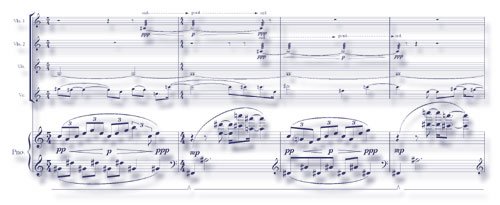
Shimmer (2006),
for piano quintet, is influenced by a recent hike
I took in the Syracuse area. One evening in early
spring, shortly before sunset, I sat alone by a
lake, completely surrounded by dark, tree-covered
hills. As the sun began its final descent below
the horizon, fewer and fewer beams of light found
their way through the shadows of the trees. A light
breeze wisp across the lake causing tiny ripples,
and a shimmering dance of lights began on the surface
of the lake. The sun slowly departed, and the flickering
of lights gradually came to an end, leaving the
lake a dark mirror. Although the piece is not specifically
programmatic, Shimmer is a very much musical depiction
of the images I witnessed that day. Shimmer
is a single movement work of approximately 11 minutes
and was commissioned by and is dedicated to the
performers of the Meridian Phase II ensemble
Premiered at Weill
Hall at Carnegie Hall, New York City, New York,
March 6, 2006.
Meridian Phase II ensemble.
|
Fractured
Mirrors (2005)
|
for chamber ensemble
(flute, clarinet, violin, cello, piano)
Duration = Circa 9 1/2 minutes
click
here for mp3 file
|
Fractured
Mirrors, for flute, clarinet, violin, cello
and piano, was composed in the winter of 2004-2005.
My initial goal was to compose an energetic and
rhythmic piece that would be fun to play and that
would feature the piano, but as I continued to work
on the piece, the piano and other instruments became
much more integrated. Thus, this piece is very much
an ensemble piece, and each instrument is as important
as the other. As is the case in most of my works,
timbre and color play an important role in the development
of the musical materials throughout the piece. The
five instruments continually pass motives around
in a kaleidoscopic manner. As the title suggests,
another important element in the piece is the idea
of a broken or fractured mirror. As I worked on
the musical material, I imagined what it would be
like to write some music and then reflect a page
of that music onto a broken mirror. Music that had
initially appeared continuous would now rematerialize
in splintered fragments.
Fractured Mirrors was commissioned
and premiered by the Society for New Music in 2005.
The piece is dedicated to Steve Heyman, piano, and
the Society for New Music with much admiration and
gratitude.
Premiered in Syracuse,
New York, March, 2005.
Society for New Music
|
|
Whisper
(2004)
|
|
I began working on
Whisper in the fall of 2004 and my initial
intent was to create a piece that was quiet and
very intimate throughout, in other words, a "whisper"
of a piece. As I began working on the music and
as I began considering the different ways in which
we whisper and it became clear to me that a "whisper"
can have a variety of nuance and intensity, and
this became the focus of my work. I have long admired
the drive and energy that the “string quartet”
can create. Thus, although this is a quiet piece,
it is also very intense throughout. It is my hope
that, just as one might struggle or strain to hear
the specific details of a whisper, the listener
will have to listen very intently to all the details
that happen in this very quiet yet hopefully dramatic
and energetic piece for string quartet.
Whisper was composed for the Cassatt
String Quartet, and the piece is dedicated to them
with thanks and admiration. It was premiered in
Blacksburg, Virginia, on the Musica Viva! concert
series on January 30, 2005.
Premiered in Blacksbourg, Virginia,
January 30, 2005.
Cassatt String Quartet
|
|
Till
I become accustomed to the dark (2004)
|
|
This set of four songs
for soprano and guitar is based on sonnets by Edna
St. Vincent Millay. For the past few years I have
wanted to write a piece for solo guitar for Ken
Meyer, as well a song cycle for Janet Brown. It
just so happens that when I talked to both Ken and
Janet about the possibility of writing a set of
songs for soprano and guitar, they immediately became
very excited about the possibilities. Janet introduced
the work of Edna St. Vincent Millay to me this summer
and, after being immersed in much of her poetry,
I found four sonnets that I thought would work particularly
well for a song cycle. To me, the first song is
about the sufferings of loss. There is a tone of
overwhelming darkness that permeates throughout
the text. The second and third songs have to do
with time and how time is a source of tremendous
agony as well as eventual relief. To me, the last
song is an acknowledgment and acceptance of definitive
truth. This is reflected in the final line of the
sonnet, “till I become accustomed to the dark,”
which expresses how each of us must learn to meet
head-on the reality of loss and the darkness that
accompanies it. When I first read this last line
of text, I immediately knew that I had found the
title for my song cycle. Many thanks go to both
Ken and Janet, two masterful musicians and wonderful
people, and these songs are dedicated to the two
of them with admiration
|
|
Colloquy
(2002)
|
for
solo violin and chamber ensemble
(solo violin, flute, clarinet, harp,
2 violins, viola, cello)
Duration = Circa 11 minutes
click
here for mp3 file
|
“…in the
form of a dialogue.” This is the motivation
behind Colloquy, for solo violin
and chamber ensemble. Although this piece is very
much a concertino for solo violin and chamber ensemble,
rather than any recognizable distinction or struggle
existing between the soloist and the ensemble, there
is much more of a dialogue, an exchange of ideas,
between them. In fact, all the music that the ensemble
performs comes directly from the solo violin music.
Colloquy was composed for and premiered
by Musica Nova under the direction of Bradley Lubman.
Premiered in Rochester, New York,
October, 2002.
Musica Nova, Bradley Lubman director
|
|
Dark
Wind, Dark Rain (2002)
|
for oboe, bassoon and piano
Duration = Circa 13 minutes
|
Premiered by the Gardenia
Trio,
Maria Cueva-Mendez, piano, Kimberly Persia, bassoon,
and Marlen Vavrikova, oboe,
at the International Double Reed Society Conference,
Banff, Alberta, Canada, August 9, 2002
|
|
Through
a Winter Landscape (2001)
|
for
soprano saxophone and harp
Duration = Circa 13 minutes
click
here for mp3 file |
When Julia Nolan approached
me about writing her a piece for saxophone and harp,
my immediate impulse was to compose a work that
would evoke some aspect of my youth. I have always
been interested in the mysterious and ambiguous
in music, and I can think of nothing more mysterious
than a winter in the Okanagan Valley in British
Columbia where I grew up. From spring through fall,
the dry, semi-desert climate of the region attracts
people from all over the world who seek adventure
in one of the most naturally beautiful places on
earth. By late November, gray and dark clouds fall
deep into the valley and snow lightly covers the
land. The lake on the valley floor takes on a haunting
blue-gray color, and the valley seems devoid of
life. The valley remains this way until late March
or early April, when the clouds begin to lift and
gray turns back into vivid colors and life slowly
returns.
Through a Winter Landscape takes the listener through
a musical sound world very similar to the visual
one described above. The work begins with the beautiful
sonorities typical of the harp and the soprano saxophone.
Eventually, these wonderfully bright colors fade
away into the darker characteristics of the two
instruments. The piece remains in darkness for quite
some time, with both instruments struggling toward
a light they eventually reach in the last moments
of the piece. The music remains highly lyrical throughout.
Although during the composition of this piece I
used the imagery of the Okanagan Valley of my youth
as an inspiration for the composing of the piece,
it is my hope that, in its musical form, the work
will penetrate beyond our concrete realities into
other “realities”. As in all my work,
I am attracted to the mysterious in music because
of its ability to draw us closer to something that
is inexpressible. In many ways, this work portrays
in music a winter landscape that I remember from
my youth that I am incapable of depicting in words.
Through a Winter Landscape was commissioned by Julia
Nolan with help from a grant from the Canada Council.
The work was premiered by Julia Nolan, saxophone,
and Rita Constanzi, harp, in Vancouver, British
Columbia, Canada, on January 13, 2002, and is dedicated
to them with thanks and admiration.
Commissioned by Julia Nolan and
the Canada Council.
Premiered in Vancouver, British Columbia, Canada,
January 13, 2002.
Julia Nolan, saxophone, Rita Costanzi, Harp.
|
|
Elegy
(2000)
|
|
Elegy,
for violin and piano was written in the spring of
2000 and was the last piece I composed as a graduate
student at the Eastman School of Music. The work
is essentially a brief, but very colorful ‘song’
for violin and piano. I have always been very interested
in the use of color as an expressive musical device.
When thematic and harmonic materials return, they
are often altered in texture and timbre. Just as
in life, the music never merely repeats itself,
but instead goes through subtle changes. Elegy
is a quiet and delicate piece, and though the violin
has some arioso moments in the piece, the violin
and piano essential work together as one.
|
|
Mirage
(1998)
|
|
Mirage,
for alto saxophone and piano, is a short, single
movement work that explores the visual effect of
a mirage, but in an aural sound world. Musical ideas
are continually shifting, appearing and then suddenly
disappearing, producing effects of surrealism and
distorted realities. By about the halfway point
into the piece, both the saxophone and piano attempt
to "attach" themselves to a single idea
in hopes of solidifying reality. After an intense
struggle, the opening "mirage-like" elements
return and the piece "wisps" away.
Mirage is dedicated to my good
friend, saxophonist Jon Gudmundson.
Premiered in Rochester, New York.
April 23, 1998
|
|
Other
chamber works:
Four Bagatelles for Alto Saxophone
and Piano (1996)
i. Utterance, ii. Crystals, iii.
Meditation, iv. Outburst
Duration = Circa 15 minutes
Premiered in Rochester, New York. May 1997
Three Pieces for Brass Quintet
(1994-95) revised 1999
i. Mosaic, ii. Interlude, iii.
Scherzo
for Brass Quintet: 2 C tpts, F hn, tbn, tba
Duration = Circa 15 minutes
Premiered at the Woolard Gallery, Rochester, NY,
May 1999
|
|
| back
to top |
|
|
Shadowed
(2006)
|
|
Shadowed
(2006) is a single movement piece of approximately
eleven minutes for soprano saxophone and can be
performed as a solo soprano saxophone piece, or
with computer accompaniment (the preferred version).
The computer listens to the pitch (frequency) of
the saxophone throughout the performance for cues,
leaving the saxophonist in complete control of the
pacing of the piece. All the electro-acoustic sounds
originate from the live saxophone sound; there are
no pre-recorded sounds, and all the sounds from
the computer are processed at close to real-time.
Therefore, as the title suggests, the saxophonist
is “shadowed” throughout the piece by
the electro-acoustic sounds. Most of these sounds
consist of delayed effects that are modulated or
filtered. The computer also records the saxophonist
during the performance and then plays back granulated
samples near the end of the piece. Shadowed
was commissioned by Randall Hall, who premiered
the work at the 2006 North American Saxophone Alliance
Conference in Iowa City, Iowa, and the piece is
dedicated to him with admiration.
Premiered
at the 2006 North American Saxophone Alliance Biennial
Conference,
Iowa City, Iowa, February, 2006.
Randall Hall, saxophone
|
|
immoral
minority (2004)
|
for
solo piano
Duration = Circa 7 minutes
click
here for mp3 file |
immoral minority
was composed shortly after the 2005 United States
presidential election and is a very personal response
to the sequence of events that followed. On the
morning after the election, I did what many other
people in the United States did; I turned on the
television to hear the election results. Suddenly,
I was overwhelmed by an interview of a woman who
had voted for the now re-elected president. She
shared with the reporter how ecstatic she was that
“America had voted for morality,” thus
insinuating that the only moral candidate was the
incumbent, and that the 40 million plus American
citizens who had voted for the other candidate were
“immoral.” This piece is a result of
the emotions and feelings that persisted in me for
the next few days.
immoral minority was composed for
and premiered by Adrienne Kim and the work is dedicated
to her and the other 40 million plus American voters
who suddenly became an immoral minority with one
vote.
Premiered at the Aaron Copland
School of Music, City University of New York, Samuel
J. & Ethel Lefrak Concert Hall, Flushing, New
York, on November 30, 2004.
Adrienne Kim, piano
|
|
Schism
(2003)
|
3
improvisations for saxophone and interactive computer
Duration = circa 15 minutes
mp3 file available soon |
Schism
(2003) is a set of three improvisations for
saxophone and interactive computer. The major difference
between "Schism" and
many traditional works that combine live instruments
with electronics is the fact that in these works
the computer and the performer interact with one
another in real time. Each piece consists of a collection
of pitch materials and special effects that the
saxophonist improvises freely with. The computer
reacts to the saxophonist producing a series of
sounds based on what the saxophonist plays. The
computer is also capable of creating random elements
throughout a work, thus allowing the saxophonist
to react to the computer. The interactive computer
environment is designed to maximize flexibility
in performance to generate, layer, and route musical
material with the same improvisational freedom that
one might develop with a purely acoustic instrument.
Thus, each performance of the piece will vary slightly.
The technical setup for "Schism" is relatively
simple. One needs a saxophone, a microphone, a computer
capable of running MAX/MSP, an audio interface with
input and stereo output, and a pair of speakers.
Many of the sounds generated by the computer come
directly from digital signal processing algorithms
that manipulate the live sound from the saxophone.
The saxophone sound (signal) is sent directly into
the computer, where pitch, amplitude, and overtones
are detected by the computer interface. Specified
orders of pitches and/or extended techniques then
determine the types of sounds that the computer
will produce.
At the core of these pieces is the interface that
I developed using the MAX/MSP environment. This
interface coordinates MIDI continuous control messages
from the signal data from the saxophone (pitch,
amplitude, and overtone detection) - mapping them
into real-time performance processes. The interface
encompasses numerous palettes of live-sampled sounds,
interactive compositional and mixing algorithms,
and live digital signal processing algorithms for
harmonization, modulation, comb filtering, various
delays, and granular synthesis. Some of these digital
signal processes draw on the PeRColate externals,
a collection of MSP externals developed by Dan Trueman
and Luke DuBois, with additional credit to Miller
Puckette for his pitch and attack detection externals.
Commissioned and premiered
by Randall Hall, saxophone,
World Saxophone Congress, Minneapolis,
Minnesota, July 12, 2003.
|
Calico
Dances (2002)
|
for
solo viola and electronic sounds
(CD playback)
Duration = Circa 8 minutes
click
here for mp3 file |
Calico Dances
is a “dance” for solo viola and electronic
sounds (CD playback). Rather than being a suite
of separate dance movements, this piece is presented
as a continuous work in which the viola “dances”
in juxtaposition to the electronic sounds. The result
is a musical patchwork.
Calico Dances was written for John
Graham and the work is dedicated to him with thanks
and admiration.
Premiered
in Rochester, New York, February, 2002.
John Graham, viola
|
|
Solitude
(2001)
|
for
alto saxophone and electronic music
(CD playback)
Duration = circa 13 minutes
click
here for mp3 file |
Solitude, for alto saxophone
with electronic music (CD playback), explores the
concept of being alone, separated from society.
The saxophone represents the individual, while the
electronic sounds portray society. Throughout the
piece, the saxophone seeks solitude. An unavoidable
conflict arises when the individual realizes that
everything it has ever known originates from the
very society from which it is struggling to escape.
In the end, the question still remains: is solitude,
that is, complete separation from society, truly
achievable? Does the saxophone find a way to exist
separately from the electronic sounds, or are the
two forced to find a way to integrate together?
Solitude was commissioned and premiered
by my good friend Randall Hall and the work is dedicated
to him with admiration.
Performed by Randall
Hall, saxophone, in Rochester, New York (premiere,
February 2001), Gent, Belgium and Luxembourg (March
2001).
|
|
Amid
the Shadows (1997)
|
for
solo piano
Duration = Circa 8 minutes |
Premiered in Rochester,
New York, April 1999
|
|
San
Juan Fog (1997)
|
for solo
marimba
Duration = Circa 12 minutes |
Premiered by Kristen
Tait, Rochester, New York, May 1997
Additional Performance in Banff, Alberta, Canada.
October 1997
|
|
Approaching
Metamorphosis (1991)
|
for solo
piano
Duration = Circa 15 minutes |
Composed for, dedicated
to, and premiered by Jeffrey Gilliam,
Bellingham, WA. Feb. 1993
|
|
Other
solo works:
5 Etudes for Alto Saxophone
(1998-99)
Duration = circa 8 minutes
Premiered at the Woolard Gallery, Rochester, NY,
April 1999
Dual Personality (1996)
for solo Alto Saxophone
Duration = Circa 8 minutes
Premiered in Rochester, New York. May 1997
|
|
| back
to top |
|
|
Till
I become accustomed to the Dark (2004)
|
for
soprano and guitar
Text by Edna St.Vincent Millay
Duration: circa 18 minutes
mp3 files (click below)
song#1-mp3file
song#2-mp3file
song#3-mp3file
song#4-mp3file
|
This set of four songs
for soprano and guitar is based on the sonnets by
Edna St. Vincent Millay. For the past few years
I have wanted to write a piece for solo guitar for
Ken Meyer, as well a song cycle for Janet Brown.
It just so happens that when I talked to both Ken
and Janet about the possibility of writing a set
of songs for soprano and guitar, they immediately
became very excited about the possibilities. Janet
introduced the work of Edna St. Vincent Millay to
me this summer and, after being immersed in much
of her poetry, I found four sonnets that I thought
would work particularly well for a song cycle. To
me, the first song is about the sufferings of loss.
There is a tone of overwhelming darkness that permeates
throughout the text. The second and third songs
have to do with time and how time is a source of
tremendous agony as well as eventual relief. To
me, the last song is an acknowledgment and acceptance
of the definitive truth. This is reflected in the
final line of the sonnet, “till I become accustomed
to the dark,” which expresses how each of
us must learn to meet head-on the reality of loss
and the darkness that accompanies it. When I first
read this last line of text, I immediately knew
that I had found the title for my song cycle. Many
thanks go to both Ken and Janet, two masterful musicians
and wonderful people, and these songs are dedicated
to the two of them with admiration.
|
|
Winter
Privacy (1999)
|
for
mezzo-soprano and piano
(also
available for tenor and piano, and soprano and piano)
Text by Arthur Bly
|
Tenor version premiered
at the Woolard Gallery, Rochester NY, April 1999
|
|
Create
in Me (1997)
|
for
A Cappella Choir (SATB)
Duration = Circa 2 minutes |
Commissioned by and
performed by the Salem Chancel Choir,
Premiered at the Salem Church of Christ, Rochester,
NY, March 1997
|
|
| Night
City (1992) |
for
soprano and chamber ensemble
(soprano voice, flute, clarinet, violin,
cello, piano, percussion) |
Premiered in Bellingham,
Wa., The Western Washington University Chamber Players,
Roger Briggs, conductor.
|
|
| back
to top |
|
|
|
|
|
Jon's
Point, LA (2001)
|
Film
with electronic music
Jack Beck, filmmaker
Nicolas Scherzinger, composer
Duration = circa 3 1/2 minutes |
Performed at SUNY
Brockport, Brockport, New York, April 7, 2001
and at the Rochester Institute of Technology, Rochester,
New York, April 15, 2001
|
|
|
Other
electronic works:
Tui (2000)
Film with electronic music
Jack Beck, filmmaker; Nicolas Scherzinger, composer
Duration = circa 17 minutes
Performed at SUNY Brockport, Brockport, New
York, April 16, 2000
Niagara (1999)
Film with electronic music
Jack Beck, filmmaker; Nicolas Scherzinger, composer
Duration = circa 5 minutes
Premiered at SUNY Brockport, Brockport, New York,
April 1999
Loon Calls (1996)
electronic music
Duration = 8 minutes Reflections
on Water (1995)
electronic music
Duration = 9 minutes
|
|
| back
to top |
| |
|